
Purpose: Allows you to reprogram or recode all data for the new battery after it has been replaced.
SFD: yes
Watch out! There are 4 lines of coding to do here.
Proceed :
1 – Engine off, ignition off, connect your official VAG-COM VCDS cable to the computer, then plug the other end into your vehicle’s diagnostic socket or OBDeleven box.
2 – Switch on the ignition and run the VCDS program or the OBDeleven application.
Line 1:
3 – Click “Select,” then click “19 – CAN Gateway.”
4 – Click ” Adaptation – 10.”
5 – At the very top of this page, there is a drop-down menu.
From this drop-down menu, select “Battery Adaptation—Nominal Battery Capacity.”
6 – On this same page, there is a second drop-down menu toward the bottom
.
From this menu, select the rated capacity listed on your battery. For example: “70Ah“
Line 2:
3 – Click “Select,” then click “19 – CAN Gateway.”
4 – Click “Adaptation – 10.”
5 – At the very top of this page, there is a drop-down menu.
From this drop-down menu, select “Battery Adaptation—Battery Technology.”
6 – On this same page, there is a second drop-down menu further down
.
From this menu, select the corresponding value
. For example: For the VARTA E39, select “Etoffe” / “Fleece” for AGM.
Line 3:
3 – Click “Select,” then click “19 – CAN Gateway.”
4 – Click “Adaptation – 10.”
5 – At the very top of this page, there is a drop-down menu.
From this drop-down menu, select “Battery Adaptation—Battery Manufacturer.”
6 – On this same page, there is a second drop-down menu further down the page
.
From this menu, select the corresponding brand:
For example: For the VARTA E39, select “VAO.”
Line 4:
3 – Click “Select,” then click “19 – CAN Gateway.”
4 – Click “Adaptation – 10.”
5 – At the very top of this page, there is a drop-down menu.
From this drop-down menu, select “Battery Configuration—Battery Serial Number.”
6 – On this same page, there is a second drop-down menu toward the bottom
.
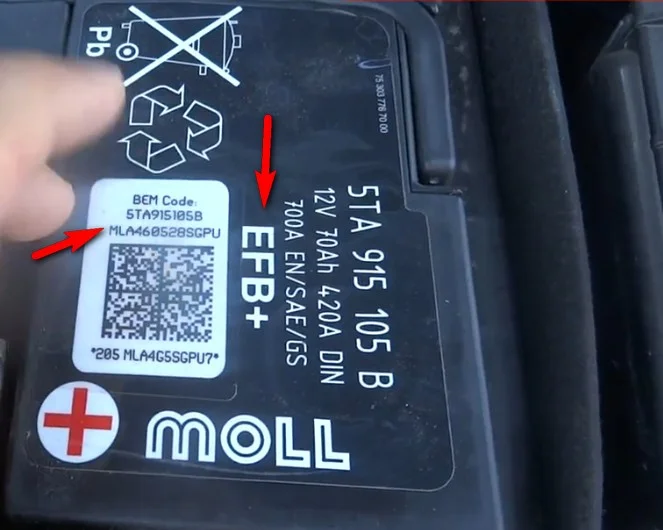
In this menu, enter the corresponding serial number:
Note: Enter only the last 10 digits of the serial number.
Battery Status Detection Features:
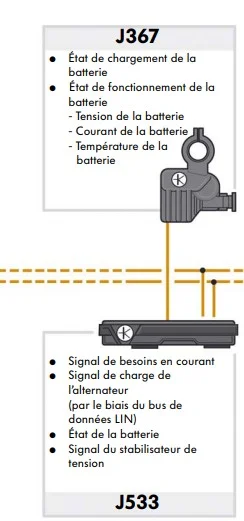
Battery status detection in the battery data module calculates the following quantities, which are transmitted via the LIN bus to the J533 data bus diagnostics interface:
1 “Battery non-existent” detection: if the battery data module detects no battery for
more than 30s, a corresponding bit is set to a
2 voltage momentarily allowing optimum charging of the battery
3 “Motor startability” bit. This indicates whether or not the battery is momentarily able to start
the engine
4 charge that can momentarily still be drawn from the battery before reaching the
engine startability limit
5 current state of charge of the battery
6 battery ageing. Battery ageing can be determined via quantities such as energy storage capacity and momentary battery power.
7 battery quiescent voltage
8 battery internal resistance
The battery sensor in the J367 battery monitoring control unit:
Knowing whether the battery has enough electrical energy to restart the engine is essential for the start-stop system to function properly.
The control module is located directly on the “negative” terminal of the ground wire and is connected to the diagnostic interface via the LIN data bus.
Signal Usage:
The battery sensor records the following values:
– Battery temperature
– Battery voltage
– Charging current
The battery temperature is calculated using a lookup table and the ambient temperature.
It also allows for estimates of the battery’s charging time.
Using the data obtained in this way, it is possible to adjust the charging control—particularly the charging voltage—to the battery’s state of charge and operating conditions. The goal is to increase the availability of the start-stop system by optimally utilizing data from the starter battery.
Consequences in the Event of a Malfunction
If the battery sensor is defective, the battery status can no longer be detected correctly.
A fault is logged in the diagnostic interface’s fault memory. The start-stop system is deactivated.
Battery
The vehicle’s battery is housed in the engine compartment and protected by a battery tray. The size and type of battery depend on the engine version, equipment, and country-specific variant. Standard batteries, EFB batteries, and AGM batteries are used.
Vehicles with gasoline engines and start/stop systems are equipped with an EFB battery, while vehicles with diesel engines and start/stop systems are equipped with an AGM battery. Vehicles with auxiliary heaters typically have an AGM battery.
EFB
An EFB battery (short for Enhanced Flooded Battery) is a reinforced flooded battery. The positive plate inside the battery is coated with an additional layer of polyester mesh. This provides the battery’s active material with additional support on the plate. These batteries have greater resistance to charge-discharge cycles than standard batteries. During charging, an EFB battery is treated like a standard battery.
AGM Battery
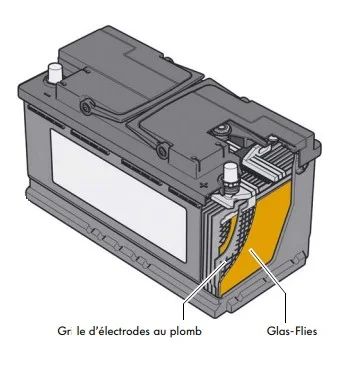
In AGM (Absorbent Glass Mat) batteries, the battery electrolyte is retained within a microporous glass mat. An AGM battery is characterized not only by even greater resistance to charge-discharge cycles compared to an EFB battery, but also by its leak-proof design. When charging, follow the charger’s user manual and, if applicable, select the AGM battery program.
In the case of AGM batteries, the automotive battery electrolyte is retained in a micro-porous glass mat. In addition to
increased resistance to alternating cycles, an AGM battery is characterized by its good sealing properties. Waterproofing is of crucial importance
, especially when the battery is installed in the passenger compartment. When charging, please follow the charger’s operating instructions and select the program for
AGM battery, if applicable.
Below, we can see the brand, serial number, and manufacturer of the battery